March 10, 2026
[GLAUCOMA: THE SILENT THIEF OF VISION]
Glaucoma is a chronic and progressive disease of the optic nerve. It is a very serious disease because:
The problem is that it does not cause symptoms (burning, pain, etc.) and, as such, it progresses silently if it is not diagnosed during a routine eye exam.
As mentioned, this is a patient who does not cause any symptoms (burning, stinging, or other complaints) or who causes visual changes at an early stage. It is not uncommon to see patients in the clinic or emergency room who are visiting us for the first time and have lost vision in one eye, only to discover that they have end-stage glaucoma in the other eye (although they are not blind). It is a highly treatable disease if high intraocular pressure (IOP) is controlled. But this is not always the case, which is why it is important to evaluate the rest of the eye: measuring the iridocorneal angle and detecting characteristic lesions in the optic nerve ("glaucomatous excavation"). Optical coherence tomography (OCT) and visual field tests will corroborate the diagnosis and tell us how severe the disease is.
It is a multifactorial disease in which the most important factor, and the only one that can be modified, is high intraocular pressure (IOP). However, this is not always the case, which is why it is important to evaluate the rest of the eye: measuring the iridocorneal angle and detecting characteristic lesions in the optic nerve ("glaucomatous excavation"). Optical coherence tomography (OCT) and visual field tests will corroborate the diagnosis and tell us how severe the disease is.
Unfortunately, no. Once vision is lost, it cannot be recovered. Glaucoma treatment can delay or, ideally, prevent the progression of this disease. Eye drops and/or laser treatment and/or surgery may be used. Screening is not currently carried out, so people considered to be at risk are referred for consultation: those over 40, with a family history of glaucoma, black people, those with high myopia, or patients taking corticosteroids. Early detection will enable the diagnosis of those with this condition and its treatment, preventing its progression and, ultimately, blindness. Hence the importance that the SPO attaches to disease awareness and the need for routine consultations with ophthalmologists. They are the only professionals capable of diagnosing, monitoring, and treating those suffering from this frightening condition.
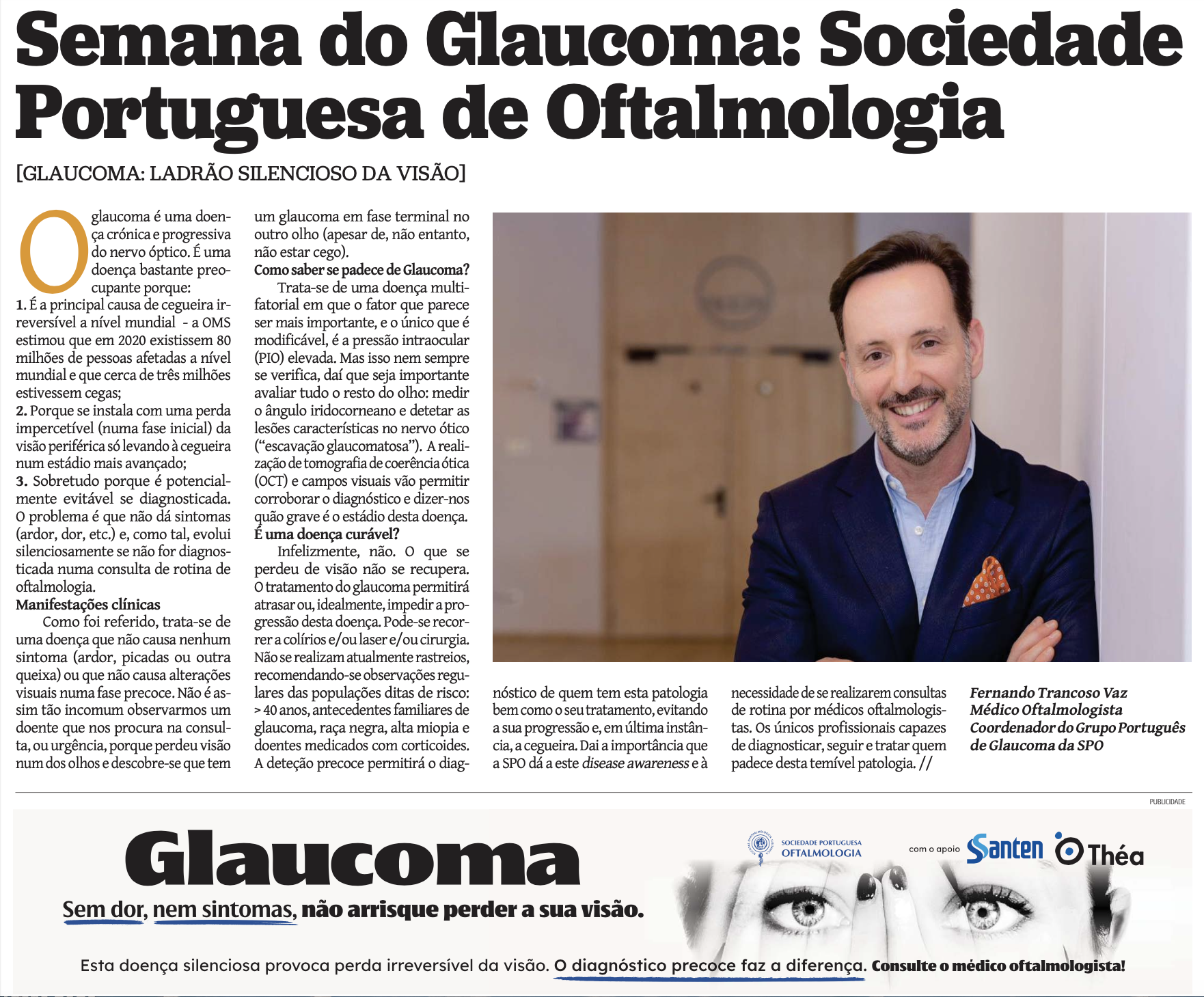
Fernando Trancoso Vaz
Ophthalmologist
Coordinator of the Portuguese Glaucoma Group of the SPO